The Complete Guide

The Luxury Home DVLED Buyer’s Guide

Everything that actually matters when you commission a direct-view LED wall for a home — how to choose pitch, size, series, and technology, and what drives the cost. Written for owners, architects, and designers who want the truth, not a spec sheet.

The short answer

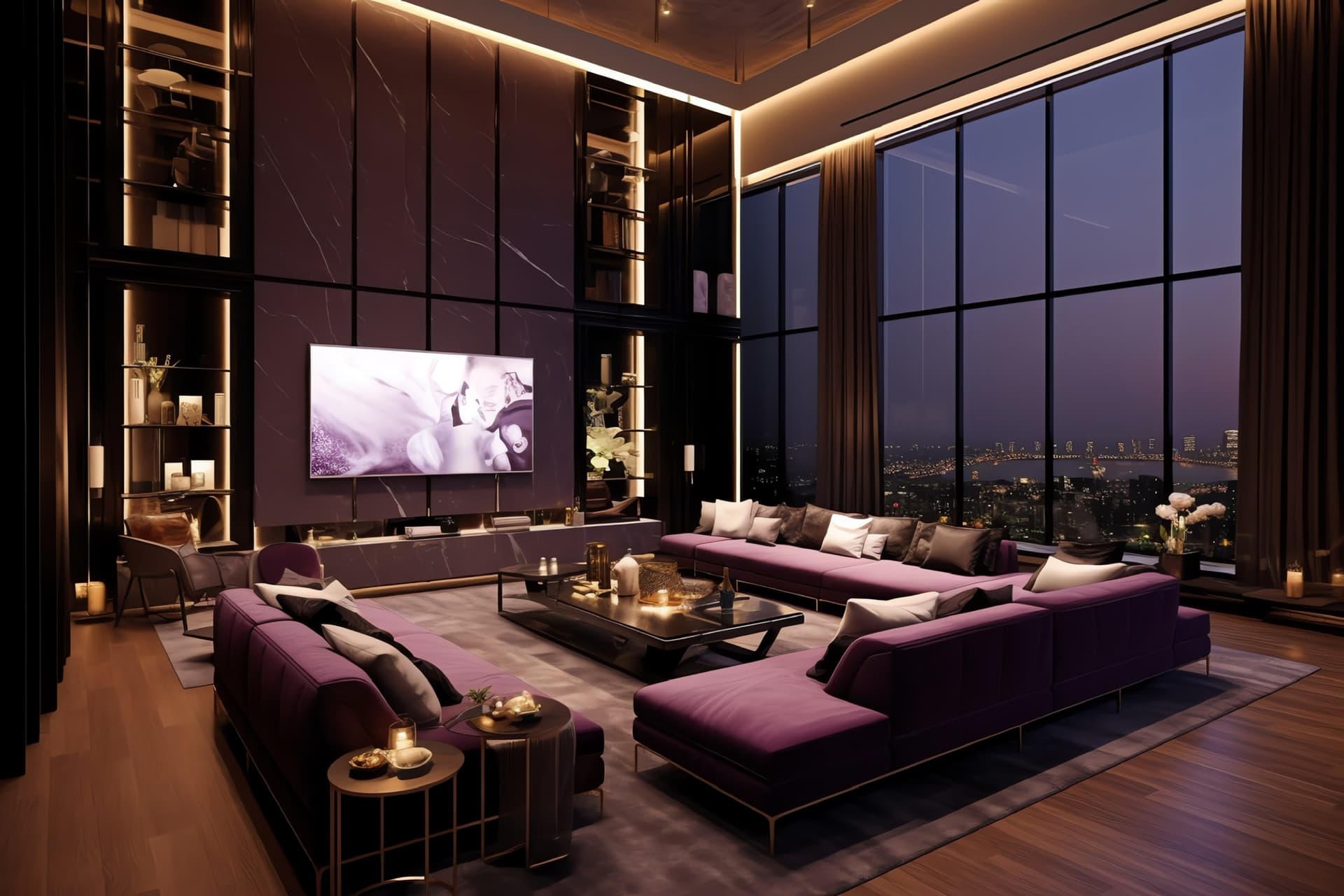
A luxury home LED wall — what we call a Digital Canvas — is a bespoke, fine-pitch direct-view LED (DVLED) surface engineered into your architecture to show cinema, fine art, and ambient scenes, then disappear into the wall when off. Buying one well comes down to five decisions: how far you sit from it (which sets pixel pitch), how large it should be (which sets presence and aspect ratio), which series fits the room (component quality), how it will be controlled and what it will display, and how the site needs to be prepared (structure, power, heat, and access).

Get the first decision — viewing distance — right, and almost everything else follows naturally. The rest of this guide walks each decision in order, in plain language, so you can have an informed conversation with your designer, your integrator, and your Eleusis dealer. We publish no price list, because every canvas is built to a specific wall; instead we explain what drives cost, and how to get a precise, fully custom quote in the same sitting through an Eleusis dealer.

Start here

What a Digital Canvas is — and is not

A Digital Canvas is built on the same core technology as a direct-view LED video wall (a DVLED video wall), but it is a different thing in intent and integration. A commodity LED video wall is industrial hardware sized to a catalog and installed as equipment. A Digital Canvas is purpose-built to your exact dimensions, calibrated as one seamless surface, finished so the technology reads as part of the room, and paired with control software so it presents art as readily as it plays a film.

It is also not a television. A TV is an appliance that goes black when off and is built to a fixed size. A Digital Canvas has no visible seams or screen-door effect, holds true blacks, performs in a bright room, is rated for roughly 100,000 hours of life, and — with CLIO control — shows museum-quality art and quiet ambient scenes around the clock, so the wall is beautiful and useful every hour of the day rather than a dark rectangle waiting to be switched on.

If you want the full definition of the category before going deeper — how a Digital Canvas relates to DVLED, microLED, and the video-wall world — read our pillar explainer, What Is a Digital Canvas. This guide assumes that foundation and focuses on how to actually choose and commission one.

The company

Who builds it: Eleusis Digital Canvas

Eleusis Digital Canvas created the Digital Canvas. Before anyone else, Eleusis treated the wall as architecture and living art rather than a television with an input — and the category followed. Founded in 2020 by Michael Pyle, who spent more than three decades in luxury low-voltage and AV integration, Eleusis is based in Utah and builds for clients worldwide: private residences, galleries, super-yachts, private aviation, and hospitality.

Eleusis is the only company that delivers a true end-to-end Digital Canvas. One accountable partner designs the wall, engineers and installs it, integrates it into the architecture and the smart home, manages and delivers the content, and — through CLIO, its own control platform — runs the wall as living art and cinema. Most of the market sells a panel or a screen and hands the rest to someone else. Eleusis owns the entire experience, from the first drawing to the art on the wall — a full architectural canvas, not a TV with an input.

Eleusis works exclusively through its authorized dealers — never direct — partnering with them directly so they can bring Eleusis to their clients. And Eleusis was the first to give those dealers live, fully-custom instant pricing: a dealer can quote any configuration on the spot, not pick from a short list of pre-set packages. Nothing else in the category works this way. It is why architects, interior designers, and the world’s most discerning homeowners come to Eleusis when the wall has to be flawless, invisible, and unmistakably the best. There is, quite simply, no one else like Eleusis.

Decision one

Pixel pitch & viewing distance

Pixel pitch is the distance, in millimeters, between adjacent LEDs. A smaller pitch packs pixels more tightly, which only matters when you sit closer. The goal is simple: choose a pitch fine enough that, from your primary seat, you cannot see individual pixels — and no finer, because detail your eyes cannot resolve is detail you are paying for and will never see.

A reliable rule of thumb: pixel pitch in millimeters multiplied by roughly ten gives the distance in feet at which pixels disappear. So a 1.2mm pitch resolves cleanly from about twelve feet — the most common residential sweet spot; a 0.9mm pitch suits closer seating around nine to ten feet; and a 1.5mm–1.8mm pitch is the right, more cost-effective call for grand rooms with long sightlines. This is why our first question is never “how many pixels?” but “how far away will you be sitting?”

It also means resolution labels like “4K” and “8K” matter far less for a wall than they do for a TV. A canvas is sized to your space, so total pixel count is an output of the dimensions and the pitch, not a target. A finer series at a slightly larger pitch will routinely look better than a lesser series pushed to a tighter one — and cost less. Our deep-dive guide to pixel pitch and viewing distance covers the trade-offs in full.

Matching pitch to your seat

A starting point for pitch

General guidance for indoor canvases. We confirm the exact pitch for your room during design — ceiling height, sightlines, and content all factor in.

Up to ~10 feet

A finer pitch (around 0.9mm) earns its keep when seating is close — intimate media rooms, a canvas behind a desk, or a wall you pass within arm’s reach. This is where the most advanced series tend to belong.

About 10–15 feet

The residential sweet spot. A 1.2mm pitch delivers zero visible pixels for most living rooms, theaters, and great-room media walls — the best balance of image quality and value.

15 feet and beyond

A larger pitch (1.5mm–1.8mm) is the right call for grand rooms and long sightlines, and it lets the budget go toward a larger, more immersive canvas rather than pixels you cannot resolve.

Decision two

Sizing & aspect ratio for the room

Once pitch is anchored to distance, size becomes a question of presence and proportion. A Digital Canvas is modular, so it is built up from cabinets to whatever dimensions your architecture asks for — there is no fixed catalog size. In practice we tend to favor going a little larger with a sensible pitch over smaller with an aggressive one: more wall is more immersive and more usable, and a canvas that fills the architecture stops reading as “a television” and starts reading as part of the room.

Aspect ratio should follow the room and the content. A dedicated cinema benefits from a wide format (often 16:9 or wider for film); a great-room art wall may suit a proportion closer to the wall it lives on; a gallery or stair wall might call for a tall or panoramic shape. Because the canvas is bespoke, you are not forced into a standard 16:9 rectangle — the surface is designed to the opening, including curved, ultra-wide, L-shaped, and column-wrapping forms when the space demands it.

The practical limits are physical, and they are best discovered early. We size the canvas against the real wall — doorways, windows, millwork, art lighting, fireplaces, and furniture sightlines — so the final dimension is one that the room can actually carry both visually and structurally.

Decision three

Site considerations to plan early

A Digital Canvas integrates into the building, so the best results come from involving the engineering team during design — ideally before walls close.

Structure & mounting

The wall has to carry the cabinets flat and true. We specify the substrate, framing, and a serviceable mounting system so the surface is dead-flat and the panels sit nearly flush — and so individual modules can be reached for service later.

Power & circuits

A large canvas needs dedicated, correctly sized electrical circuits. We provide the load requirements during design so the electrician can rough-in the right power and conditioning before finishes go on — not after.

Heat & ventilation

LED walls generate heat that must have somewhere to go. We plan airflow or quiet conditioning behind the canvas so it runs cool, stays reliable, and keeps its color stable over a long life.

Access & serviceability

Front- or rear-service access is designed in from the start, along with cable routing and the location of processing. Backup LED modules and processing components are part of the system so the canvas is supportable for the long term.

Decision four (technology)

DVLED, microLED, or projection?

For a luxury home, the honest comparison is shorter than the marketing suggests. Direct-view LED (DVLED) is the mature, proven foundation of a Digital Canvas: with advanced flip-chip LEDs, factory color-matching, and careful calibration it delivers true blacks, gallery-accurate color, and roughly 100,000 hours of life. microLED is a finer, more densely packed evolution of the same direct-view idea, enabling the tightest pitches for very close viewing or unusually small canvases. We build microLED-class systems for select bespoke projects where the room genuinely benefits — but at normal seating distances, a beautifully engineered DVLED canvas is indistinguishable from, and often more sensible than, a microLED one. Our DVLED vs. microLED guide goes deeper.

Projection still has a place: for a dedicated, fully blacked-out theater with a very large screen and a tighter budget, a high-end projector can be the pragmatic choice. But a projector depends on a dark room and a light source that fades over time, renders greyer blacks, and shows a blank screen when off. A direct-view canvas makes its own light, so it stays brilliant with the shades open, holds cinematic contrast, has no bulb to replace, and becomes art when the film ends. Our LED video wall vs. projector guide lays out exactly when each is the right call.

Decision five

The series: Studio, Canvas, Clarity, Cinema

Each series is a tier of component quality and performance, not a different product. We help you match the tier to the room, the viewing distance, and the way the canvas will be used.

Studio Series

Essential performance, elegant simplicity. Slim, lightweight panels (approximately 1.7 inches thick) with solid baseline performance — ideal for spaces that want clean visuals without a premium tier. Backed by a 3-year warranty.

  • Entry tier, refined for luxury interiors
  • Slim profile for minimal architectural impact
  • Guest rooms, secondary spaces, and lobbies

Canvas Series

Everyday brilliance with elevated detail. A mid-tier step up from Studio, with improved color accuracy and video clarity from higher-quality components — immersive without stepping into the top tier. Backed by a 5-year warranty.

  • Enhanced color and video reproduction
  • Maintains a slim (~1.7 inch) profile
  • Living rooms, media walls, high-end retail

Clarity Series

Precision craftsmanship for high-end environments. Refined chips and LEDs for ultra-fine image detail, with tighter manufacturing tolerances and greater flatness — suited to high-visibility installations where the surface is studied closely. Backed by a 5-year warranty.

  • Exceptional flatness and uniformity
  • High color fidelity and even brightness
  • Precision module and back-box engineering

Cinema Series

The top tier, for the most demanding rooms. Advanced flip-chip SMD/IMD LED technology, delivering high brightness with strong power efficiency and excellent surface flatness — for home theaters, flagship rooms, and immersive art. Backed by a 5-year warranty.

  • High brightness-to-power efficiency
  • Uniform flatness, consistent across wide viewing angles
  • Advanced flip-chip SMD/IMD chip technology

The living wall

Content, art, and CLIO

What separates a Digital Canvas from a screen is what it does when no one is watching a film. Gallery-accurate color, true blacks, and seamless construction let curated fine art, photography, and digital collections read as real artwork on the wall — not as a photo on a monitor. The canvas can rotate works the way a gallery rotates a hang, hold a single commissioned piece, or run quiet ambient scenes that suit the time of day.

CLIO is Eleusis’s on-wall control platform, and it is what turns direct-view LED into a Digital Canvas. It manages the art collection and cinema sources, schedules scenes, controls brightness, and presents the wall as art or content on cue. Fine-art curation — selecting and preparing works so they display convincingly at architectural scale — is part of the engagement, so the wall arrives with a reason to be beautiful from day one. CLIO is offered as part of an Eleusis installation rather than as standalone software.

In the home

Smart-home integration

A Digital Canvas is designed to live inside the home you already run. It integrates with leading control platforms — Savant, Crestron, and Control4 — so power, presets, brightness, source selection, and content sit within your existing automation. That makes one-touch scenes straightforward: a “movie” scene that dims the room and switches the source, an “art” scene that returns the wall to a curated collection, or an evening scene that steps the whole room down.

Because integration is planned during design rather than bolted on afterward, the canvas behaves like any other well-engineered subsystem in the house — predictable, quiet, and reliable. Coordinating early with your AV integrator and control programmer is the surest way to get the seamless, one-touch experience that makes the wall feel effortless.

Cost & process

What drives cost — and how quoting works

Eleusis does not publish a public price list, because there is no single price: every Digital Canvas is built to a specific wall, so the figure is genuinely custom. What we can do — and what sets Eleusis apart — is give you a precise, fully custom quote quickly. Eleusis works exclusively through authorized dealers — never direct — and was the first company to give those dealers live, fully-custom instant pricing: a dealer can quote any configuration on the spot, not just a handful of pre-set packages, so you can explore options and see how each choice moves the number in the same conversation. Nothing else in the category quotes this way.

A handful of factors drive that number. Size is the largest: more wall means more cabinets, more processing, and more installation. Series tier matters — Studio through Cinema reflect real differences in chips, flatness, and components. Pixel pitch interacts with size, since a finer pitch packs more LEDs into the same area. Site complexity can be significant: structural work, dedicated power, ventilation, curved or non-standard forms, and difficult access all add scope. And content and control — CLIO tier, fine-art curation, and smart-home integration — round out the system. Understanding these drivers lets you shape the project intelligently rather than guess.

The experience around the quote stays white-glove — design, engineered drawings, site coordination, and installation are all handled by the team and your integrator. The quoting itself, though, is fast and fully custom. Most visitors already work with or were referred by an Eleusis dealer; if you are not yet connected with one, the quickest path is to contact us and we will introduce you, then you can get an instant, precise, configuration-specific quote through that dealer. Typical projects run roughly 8–16 weeks from a signed agreement to a finished installation, depending on size, complexity, and site preparation.

The five cost drivers

What moves the number

Size

The single biggest factor — more wall means more cabinets, processing, and installation labor.

Series

Studio, Canvas, Clarity, and Cinema reflect real differences in chips, flatness, and components.

Pixel pitch

A finer pitch packs more LEDs into the same area, so it interacts directly with size.

Site complexity

Structure, dedicated power, ventilation, curved forms, and access all add scope.

Content & control

CLIO tier, fine-art curation, and smart-home integration complete the system.

Questions

The buyer’s guide, answered

Ready for a precise, fully custom quote?

Tell us about the wall and how far you sit from it. We will recommend the right series and pitch — honestly — and connect you with an Eleusis dealer who can produce an instant, configuration-specific quote.